
pyrofennec (![[personal profile]](https://www.dreamwidth.org/img/silk/identity/user.png) pyrofennec) wrote in
pyrofennec) wrote in ![[community profile]](https://www.dreamwidth.org/img/silk/identity/community.png) books2010-12-18 10:17 pm
books2010-12-18 10:17 pm
pyrofennec) wrote in books2010-12-18 10:17 pm


in the grim darkness of future there is demonic foeyay
Inquisitor Eisenhorn is one on the most senior members of the Imperial Inquisition. With his warband he scourges the galaxy in order to root out heresy. When that heresy is found to infiltrate the hierarchy of the Imperium and the Inquisition itself, he must rely on himself alone to deal with it - even if it means making deals with the enemy.
I'm gonna take a chance totaling my
My main motivation, I will not lie, in reviewing this is so I can say fuck you Jim Butcher and the giant dick you rode in on. Oh yes. For you see, Eisenhorn isn't just about BURN THE HERETICS (though it's very much about that), it's noir in space. Any WH40K book featuring inquisitors tends to be. Gregor Eisenhorn investigates crimes, gets into exciting firefights and sorcerous duels, at one point he's hunted by a fanatical witch-hunter who's convinced Eisenhorn is a heretic. He wears a storm coat, presumably made of leather, all the time. In all honesty, he bears more resemblance to Takeshi Kovacs than to Harry Dresden, but I don't really care about Richard Morgan and I dislike Jim Butcher's saga of unfunny, talentless misogynistic fuck even more than I disliked Altered Carbon, so that's that.
Honoring the great noir tradition of shittiness[1], Eisenhorn's story allows for little meaningful female presence. Unlike Hairy Dickden, however, Eisenhorn doesn't pause every few pages to make condescending little asides about the fickle, untrustworthy, and delicate nature of women. Never ever. Oh, you aren't going to laud Abnett for being a shining example of feminist ally, but compare Dan Abnett's figure of authority who's sort of getting in the hero's way:
[1] though the sequel trilogy, Ravenor, deviates far and away from this. Two major female characters! Not only that, competent female characters who actually get enough page-time to be distinct and interesting.
The inquisitor general rose from her writing desk and straightened the front of her green flannel robe. She was a short, sturdy woman in her late one tens, if my eye was any judge, with salt and pepper hair plied back tightly into a bourse. She had the typical pale, tight flesh and violet eyes of a Cadian.
...
She smiled at me. It wasn't encouraging.
'You know, Eisenhorn... I always imagined roving inquisitors like you had adventurous, exciting lives. All so very exhilarating, all that celebrity and heroism and notoriety. To think I used to dream of being like you. You have no idea, do you?'
'With respect, inquisitor general... of what?'
She gestured at the file case I was clutching. 'The crap. The nonsense. The bric-a-brac. The Sons of Bael? Why the hell should I review that case? It's dead, dead and nothing. A bunch of fools who were pulled off the West-moorland pylon in the middle of the night for playing around with geo-locators. Whoooo! I'm so scared! Imagine that, they're measuring us! Do you have any idea what this wardship is like?'
'Inquisitor general, I-'
'Do you? This is Cadia, you silly fool! Cadia! Right on the doorway of Chaos! Right in the heart of everything! The seepage of evil is so great, I have a hundred active cults to subdue every month! A hundred! The place breeds recidivists like a pond breeds scum. I sleep three or four hours a night if I'm lucky. My vox chimes and I'm up, called out to another nest of poison that the arbites have uncovered. Firefights in the street, Eisenhorn! Running battles with the foot soldiers of the archenemy! I can barely keep up with the day-to-day banishments, forget the past cases my crap-witted predecessor filed. This is Cadia! This is the Gate of the Eye! This is where the bloody work of the Inquisition is done! Don't distract me with stories of some engineering club gone bad.'
...
I always took pleasure in meeting a fellow inquisitor who conducted their work fairly and seriously, even if their methods differed from mine. Neve was a thoroughbred puritan, and lacked patience. She was abrupt to the point of rudeness. She was over-worked. But she called things as she saw them, despised sloppiness, and took the threats to our society and way of life completely seriously. In my opinion, there was no other way for an inquisitor to behave.
To Jim Butcher's counterpart:
Karrin Murphy was waiting for me outside the Madison. Karrin and I are a study in contrasts. Where I am tall and lean, she's short and stocky. Where I have dark hair and dark eyes, she's got Shirley Temple blond locks and baby blues. Where my features are all lean and angular, with a hawkish nose and a sharp chin, hers are round and smooth, with the kind of cute nose you'd expect on a cheerleader.
...
My legs were longer; I got there first. I opened the door for her and gallantly gestured for her to go in. It was an old contest of ours. Maybe my values are outdated, but I come from an old school of thought. I think that men ought to treat women like something other than just shorter, weaker men with breasts. Try and convict me if I'm a bad person for thinking so. I enjoy treating a woman like a lady, opening doors for her, paying for shared meals, giving flowers—all that sort of thing.
...
Murphy set the hook a second later. She looked up at my eyes for a daring second before she turned away, her face tired and honest and proud. "I need to know everything you can tell me, Harry. Please."
Classic lady in distress. For one of those liberated, professional women, she knew exactly how to jerk my old-fashioned chains around.
Let this sink in, slowly. Warhammer 40K is a grimdark none-too-mature macho setting that's best-known and represented by promo shots that look like this:

I realize this guy has a perfect rose pinned to his shoulder for some unfathomable reason, but still, space marines? So macho their heads almost disappear into their power armor. So macho they wax homoerotic. So, so macho. There's barely any woman in there, the rare Adepta Sororitas aside. These guys glory in their masculinity and constantly compliment each other on their noble, muscular physiques. Big guns and bigger tanks. Ridiculous chainswords--yes, that's chainsaw plus sword--and giant fucking mechas. There's no word to describe how ridiculous and over-the-top, and exclusively male, WH40K is.
Despite writing in this setting, Dan Abnett still manages not to be the misogynistic, puerile assfuck than Jim Butcher is. You know, Jim Butcher, who sets his urban fantasy in... Earth, 21st century? Earth, American Generica even. Yes, that. Eisenhorn is so much more grown-up than Harry Dresden it's not even funny.
Suffer not the alien to live
It's important to establish at the outset that Eisenhorn isn't a private investigator or some hero of justice. He's an inquisitor. As in, he works for the Inquisition: secret police who patrol the Imperium of Mankind, rooting out the alien, the mutant, the heretic. They are powerful, almost beyond the law, and naturally the citizenry is scared shitless of them. They attack with extreme prejudice and torture their captives. Sometimes to death, but no worries, they can use astropaths to drag back the spirits of the dead for continued questioning. Anything for the Emperor and Holy Terra. Anything to turn back the tides of Chaos.
Xenos being the start of the trilogy, Eisenhorn is of course not presented as a Lawful Evil individual (yet). He's more moderate than most, and fairly reasonable. He spares civilian lives when possible, because we expect our heroes to be kind of heroic, but being an inquisitor means his moral position's tenuous from the get-go however hard he protests otherwise. Remember, this man venerates an undead cadaver that's kept alive through the sacrifice of ten thousand psychics every day.
He kicked the man again, then dragged him up and threw him against the wall. He cursed at him some more and the man whimpered, pleading apologies
Locke turned away from the battered wretch. Then he picked up the revving saw, swung back, and dismembered the guard leader. It was inhuman. The agonised screams filled the chamber. All the slaves wailed and moaned, and even the guards looked away in distaste. Locked laid in with murderous glee, covering himself in blood.
A villain dismembering a poor innocent. Eisenhorn's reaction to this is, er, nothing. He just narrates it in his detached first-person way and, though it's clear he finds it distasteful, he experiences no such thing as moral outrage or horror. In the grim darkness of future, after all, everyone's a little bit psychopathic. In fact, at the start of the book, Eisenhorn chases a murderer named Eyclone, and in the process passes on mercy-killing some innocent civilians not because he reveres life, but because he's afraid the resultant paperwork and bureaucratic mire will slow down his holy task of persecuting heresy. Just so you know, the innocents in question die anyway, but painfully and slowly.
It's a set-up book. Eisenhorn discovers that a noble house is simultaneously trying to resurrect one of their ancestors, an evil dude called Pontius Glaw, and trying to get their hands on a copy of the Necroteuch. It's an artifact of great power that contains evil Chaos lore, or something. The book introduces you to Eisenhorn and his retinue--pilot, savant, fighters, all the rest--and gives you an idea of inquisitorial hierarchy and structure. In all honesty, it's a forgettable book if you find fight scenes in general as boring as I do, and perhaps decent if you don't. Eisenhorn is this close to being a Gary Stu by virtue of being the best at everything, outclassing his entire retinue except maybe the
Bequin brought in regular trays of hot mead or leaf infusions, and Brytnoth actually extended his little finger as he lifted the porcelain cups by the handle... He would lift the cup, small finger extended, consult his notes an ask another question before sipping. The fact that small finger was the size and shape of an Arbites' truncheon was beside the point.
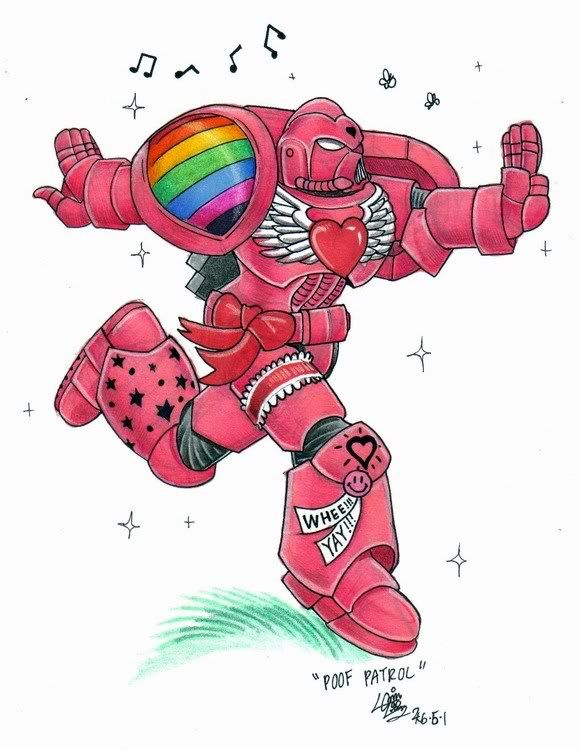
The image of a Space Marine sipping his tea, little finger out, is too precious not to quote. Sure it's not quite this, but we're getting there. Did you know there was an actual Space Marine chapter called "the Rainbow Warriors"? Well, now you do, and you can't unlearn it.
Eisenhorn's assistants/servants are not memorable and I only remember some of their names because they show up again in the next two books. They tend to be defined by one particular trait, or one particular role--Aemos is a lovable old man who collects a lot of information, Betancore is a pilot, Alizebeth Bequin occasionally shoots things and serves refreshments, and a few assorted characters are around to... shoot more things. Characterization isn't Abnett's strong point or, perhaps to be fair (because I've read Abnett's other novel Horus Rising where the characterization is decent), not in this trilogy and certainly not the way he attempts to handle too many bit characters at once. What I did like, though, was the internal inquisitorial politics and how Abnett brings the worlds Eisenhorn visits to life, if only by dint of "not as bland as Star Wars planet-hopping treks" (and limiting the planet-hopping to a few worlds rather than several dozens). Plus, the saruthi. What's not to like about aliens who drive you bugfuck insane by subjecting you to Lovecraftian geometry? Nothing, that's what.
The end of Xenos also brings in Cherubael, a daemonhost who's been haunting Eisenhorn's dreams for years, and my favorite character. You'll see why.
Purge the unclean
There are parts of Malleus where Abnett almost--almost!--transcends the stigma of professionally published fanfiction. He never quite gets there and produces genuinely amazing prose, but even then he's still a much better writer than Jim Butcher. Abnett actually writes as if he weren't a fourteen-year-old boy, to start with.
The book opens similarly to the first: Eisenhorn in the thick of combat, hunting down a heretic, and losing some of his entourage in the process. By now, a century has passed since the end of Xenos and Eisenhorn has put together a huge staff and an operation network spanning several worlds in the Helican sub-sector. Some of the core characters remain by his side, but again, Abnett doesn't invest enough in them for me to greatly care. Eisenhorn has developed a thing for the psychic blank in his employ, Alizebeth Bequin, but it's such a non-relationship (partly because he can't touch her without experiencing intense revulsion as he's a psyker) it barely rates a thought. Some of the new characters in his staff die almost as soon as you encounter them.
Things pick up pretty quickly, though: after an imperial parade--where you just know shit will hit the fan, that always happens to huge parades--Eisenhorn is accused of heresy. He's arrested by the Inquisition, tortured, then broken out by his closest staff. Even here, though, you already get some foreshadowing of what'll happen in Hereticus, namely Fischig's wavering certainty in Eisenhorn's moral character.
Oh, and Cherubael is back.
"What do you want?" I asked
"What?"
"You always want something. On 56-Izar, it was the Necroteuch. Oh, I forgot. You never want anything, do you? You're just a slave, doing another's bidding."
Cherubael frowned slightly. "Don't be uncivil, Gregor. You should treasure the fact that I have taken a personal interest in you. Most things that cross me get destroyed very quickly. I could have hunted you out years ago. But I knew... there was a bond."
...
"I have no wish to be seen as a man who would form a compact with daemons."
"I'm sure you haven't. But that is what's happening, whether you like it or not. Destiny, Gregor. Our destinies are entwined, in ways you cannot even begin to imagine. Why else would you dream about me?"
"Because it has become a central goal of my life to hunt you down and banish you."
"Oh, this is a lot more than simple professional obsession. Think, why do you really dream of me? Why do you search for me so diligently, even hiding the extent of that search from your masters?"
"I..." My mind was racing. This thing knew so much.
Delicious, demonic Foe Yay. It's just a few leers and caresses short. Come on, this exchange would be right at home in slash fanfic and the only way for it to end is in furious buttsex. Probably exotic furious buttsex since Cherubael can levitate, grow talons and possibly spit fire. Admittedly by this point he's no longer pretty, but do you know what Eisenhorn saw before meeting him back in Xenos? A "blank-eyed, handsome man" with golden skin. Seriously, dude's been dreaming of Cherubael for years before the events of the first book, and by Malleus he's been having the same dreams for something like two centuries. Dan Abnett mister, you have some explaining to do if you didn't intend the subtext.
Having broken free of the Inquisition, Eisenhorn flees for the mining world of Cinchare, where he hopes to meet his techpriest friend and grab a little something. Unfortunately, not long after arrival, Eisenhorn and Co. discover that the miners have succumbed to Chaos and have established a cult. I swear, wherever Eisenhorn goes, there Chaos is, but I guess allowing some fifty pages to go by without another cinematic action sequence would have gotten Abnett's publishing contract with Black Library terminated or something. Anyway, some incidental crap about a giant evil rock occurs and Eisenhorn retrieves Pontius Glaw, the evil guy from the first book whose sentience was preserved in an evil casket. He requires information and he knows that Glaw would have it. They come to a bargain.
I'll pause to note here that, for the first time, Eisenhorn does something genuinely stupid. Not just stupid as in making the reader think he's too stupid to live yet he'll still live by author fiat. No, this is author-intentional stupid: it's a mistake that has consequences. Vast, terrible consequences. In short, Eisenhorn is going to have broken glass rammed down his every orifice, hard. Unlike most heroes, he's not going to get away with it just because he's the protagonist.
This is what makes reading all this worth it.
Burn the heretic
Hereticus concludes the trilogy. It's also the best of the lot. You can sum it up as a series of "rocks fall, everyone dies," because that's what happens (though on one occasion, it's "a giant mecha appears, everyone dies"). This is the payload. This is where shit hits the fan.
The cold island air was full of mineral dust from the pebbles and rock mat had been atomised by its blaster fire. Rassi and Haar simply didn't exist any more. They had been vaporised by the mega-grade military weapon. My runestaff, blackened but intact, lay on a wide patch of ground that had been transmuted to furrowed glass by the hideous alchemy of blaster fire. The only other trace of them was a small, broken section of Haar's lasrifle.
Kara Swole lay twenty metres away where the blast had thrown her. She was covered in blood, and I was sure she was dead.
And I was sure we were dead too. Thuring had won. He had killed my friends and allies in front of my eyes and now he had won.
I had nothing to left to fight him with. I had nothing that could take on the power of a Titan. I'd had nothing when this one-sided duel began, and I sure as hell had nothing left now.
I...
An idea came upon me, insidious and foul, wrenched into the light by the extremity of my position.
I shook it off. It was unthinkable. The notion was revolting, inexcusable.
But it was also true. I did have something.
I had something more powerful than a Titan.
If I dared use it. If I had the audacity to unleash it.
Unthinkable. Unthinkable.
CRUOR VULT THUNDERED towards me. I uttered the last of the potent syllables and dipped my mind into the warp. Not the simmering warp-scape of the Titan's mind-link, but the true warp. Channelled by the runestaff and warded by the prayers I had ritually intoned, I flowed into a vaster, darker void.
...
Like a small sun dawning, the enslaved daemon poured out of the head of the runestaff. Its radiance lit up the dismal shore and cast a long shadow out behind the Titan.
'Cherubael?' I whispered.
'Yessss...?'
'Kill it.'
Yessss. I recall a similar situation, albeit on a much tinier and more forgettable scale, at the end of Storm Front. It involves a demon whose control Harry Dresden is trying to wrest away from his enemy, and at the last minute he finds this last nugget of ~*mental strength*~ inside himself to control said demon. The difference is that Dresden walks away from it victorious, having paid no price, having sacrificed nothing. His morals are dandy, his health is fine. Eisenhorn, well...
But there was no alternative. I made the right decision. I had released Cherubael because Cruor Vult simply had to be stopped for the good of Mankind. Now Cherubael had to be stopped, and I was forced to make a similarly hard choice. I will pay. In time. In the hereafter, when I come before the Golden Throne.
I knelt beside [Verveuk]. His yearning face looked up at me. Damn that yearning, puppy look!
'M-master...'
'Bastian, are you a true servant of the Emperor?'
'I... I am...'
'And you will so serve him in any way you can?'
'I will, master.'
'And are you pure?' Foolish question! Verveuk's damned purity had led to all his mistakes. His puritanical piety had made him a liability in the first place.
But he was pure. As pure as any man could be.
...
Chembael's deadly star came shimmering down the beach towards me.
'Forgive me, Verveuk,' I said.
'O-of course, master,' he mumbled.
'F-for what?' he added, suddenly.
Bellowing the incantations of binding, the litany of servitus, the wards of entrapment, I met Cherubael head on, the runestaff glittering with power.
'In servitutem abduco, I bind thee fast forever into this host!'
'WHAT IN THE name of hell happened here?' Fischig bellowed, his gun raised as he ran down towards me.
'Everything. Nothing. It's over, Fischig.'
'But... what is that?' he asked.
The daemonhost floated a few centimetres off the ground next to me. I had fashioned a leash from my belt, tied off around Verveuk's scorched, distended throat.
'I have trapped a daemon, Godwyn. He is bound and cannot harm us now.'
'But... Verveuk?'
'Dead. We must honour him. He has given his all to the Emperor.'
Fischig looked at me warily. 'How did you know the means to bind a daemon, Eisenhorn?' he asked.
'I have learned much. It is an inquisitor's job to know these things.'
Fischig took a step back. 'Verveuk,' he began. 'He was dead before you used his body, wasn't he?'
Heh heh heh. Wasn't he? Given his all to the Emperor, indeed. Goodbye moral event horizon, was nice knowing you.
It doesn't stop there, oh no. Having seen Eisenhorn rebind Cherubael to a man who wasn't even dead at the time, Eisenhorn's staff come to have doubts about him, and who wouldn't? It leads to rifts between them that widen more and more as the final novel goes on. Some of them abandon him. One of them betrays him to the Inquisition. What's great, though, is that you can completely see where Eisenhorn is coming from. He has to make one hard decision after another, but whereas the first truly horrible step is taken in a desperate situation, the ones that follow become easier. It gets to the point where he psychically animates a dead body, and one of his few remaining friends goes insane because of him. By the end he's using Cherubael as his weapon. Sure, by that point he doesn't have much left--he's tragically, terribly alone--but he's alone because of the mistake he made in Malleus, which led to his entire operation being wiped out in a single day. It's hamartia on a galactic scale. It's not that the grim darkness of future is mean to Eisenhorn and wants to fuck his life up. Eisenhorn's life is fucked up because Eisenhorn fucked it up. Dan Abnett, unlike most authors of this caliber, is willing to punish his protagonist.
It might just be me, but I thought the only truly compelling relationship in the trilogy was the one between Eisenhorn and Cherubael. He maintains friendships among his staff and acquaintances, but the dynamics are neither complex or interesting. Eisenhorn is too much of an emotional blank for his grief (not that he ever expresses it strongly or dwells on it) to move the reader, and likewise most of his other emotions. Cheap laughs at the demonic hoyay aside, if I think about it--who influences much of Eisenhorn's character? Who is the primary means through which Eisenhorn makes his slide toward Chaos? Who is with him at the very end? Cherubael, of course. Their conversations tend to be the most well-crafted, the most charged out of every interaction Eisenhorn has with anybody. I mean, just look at this exchange at the end.
I looked up at it. It was hard to move, hard to concentrate. There was blood in my mouth, in my eyes. "Glaw's daemonhost?"
"Gone."
"He claimed it was more powerful than you."
"You don't know how nasty I can be," it said.
I thought about that. The last of the diabolic book's pages were mere tufts of black ash, scattered across the plinth.
"Are we finished here?" it asked.
"Yes," I said.
It frowned. "I'm going to have to carry you after all, aren't I?" it sighed.
Say it with me: awwwwwww. It's so sweet.
So, do I recommend this omnibus? I was tempted to say "only if you have an interest in WH40K," but that sells it short. It's solid noir in space but with added grimdark, and not the skeevy kind. Most of all, it's one of the few stories I've read that does convincing fall-from-grace. It works in spite of the fact that I could never care very much about the protagonist's retinue, and not much either about Eisenhorn himself, which is pretty surprising. It's good enough for light entertainment, and sets up the stage for the much superior and better-written sequel trilogy featuring one of Eisenhorn's students to boot.
Last but not least, it's a fantastic and needless to say, much better alternative to The Dresden Files. If you want your fix of hard-boiled (and Eisenhorn's brand of hard-boiled makes Harry look like a bawling baby) magic-using detective, you might as well ditch Jim Butcher and pick this one up.